
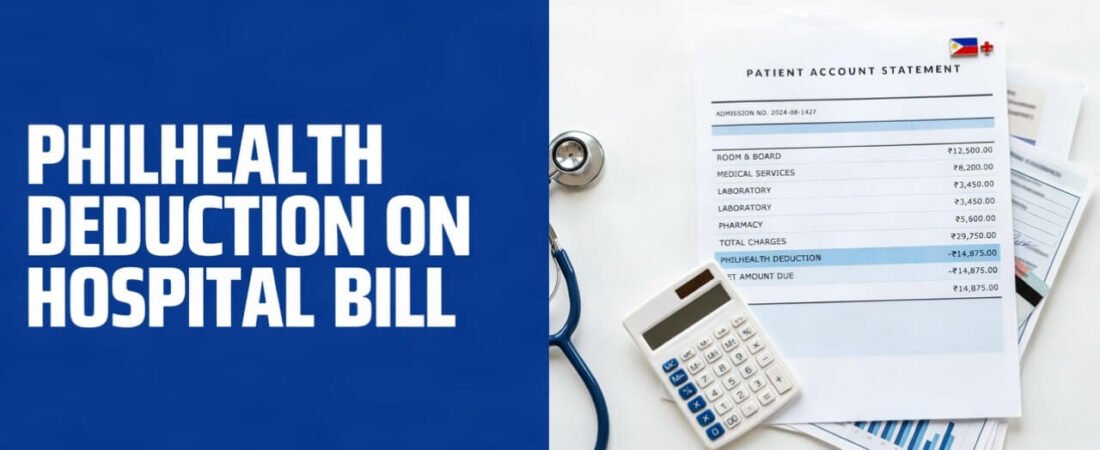
If you are admitted to a hospital in the Philippines, one of the first questions you may have is: “How much will PhilHealth deduct from my hospital bill?”
PhilHealth helps reduce the amount members pay for covered medical services. For inpatient care, PhilHealth generally pays accredited health facilities through its All Case Rates system. The applicable case rate is deducted by the hospital from the member’s total bill, including the professional fees of attending physicians, before discharge.
However, the amount deducted is not automatically a fixed percentage of your total hospital bill. It depends on the medical condition, procedure, benefit package, and applicable PhilHealth rules.
This guide explains how the PhilHealth hospital bill deduction works, what appears on your Statement of Account (SOA), why you may still have a balance, and what to do if you think the deduction was not properly applied.
What Is the PhilHealth Deduction on a Hospital Bill?
The PhilHealth deduction is the amount of your eligible PhilHealth benefit applied to your hospital bill.
For inpatient benefits, PhilHealth uses All Case Rates, meaning a predetermined amount is associated with a particular medical condition or procedure. PhilHealth pays the accredited health facility based on the applicable case rate.
The important point is that the deduction is not simply a percentage such as 50% or 70% of your total bill.
For example, if your hospital bill is ₱50,000 and the applicable PhilHealth case rate is ₱20,000, the PhilHealth benefit is not calculated as 70% of ₱50,000. Instead, the applicable benefit package or case rate determines the amount.
Simple example
Suppose:
- Total hospital bill: ₱50,000
- Applicable PhilHealth benefit: ₱20,000
- Remaining amount: ₱30,000
The example above is only for illustration. Your actual PhilHealth deduction depends on the applicable benefit and case rate for your condition or procedure.
How Does PhilHealth Deduct From the Hospital Bill?
According to PhilHealth, inpatient benefits are paid to accredited health facilities through All Case Rates.
The case rate amount should be deducted by the health facility from the member’s total bill before discharge. The total bill includes the professional fees of attending physicians. PhilHealth also states that the case rate is inclusive of hospital charges and the attending physician’s professional fees.
In general, the process works like this:
- You are admitted to a PhilHealth-accredited hospital.
- Your medical condition or procedure is identified.
- The applicable PhilHealth benefit or case rate is determined.
- The hospital processes the PhilHealth claim.
- The applicable PhilHealth amount is deducted from your bill.
- You receive your Statement of Account showing the charges and deductions.
- You pay any remaining amount that is legally and properly chargeable to you.
Is PhilHealth Deduction Based on the Total Hospital Bill?
No.
This is one of the most important things to understand about PhilHealth.
PhilHealth benefits are generally based on the applicable benefit package or case rate, rather than simply deducting a certain percentage from whatever amount the hospital charges.
PhilHealth describes its All Case Rates as a case-based payment mechanism. The benefit amount depends on the covered medical condition or procedure.
Therefore, two patients with very different hospital bills may receive the same published case rate if they have the same covered condition or procedure and the same applicable benefit rules.
What Is Included in the PhilHealth Case Rate?
For inpatient All Case Rates, PhilHealth states that the case rate amount is inclusive of hospital charges and professional fees of the attending physician.
This is important when checking your hospital bill.
You should not assume that the PhilHealth deduction applies only to room and hospital charges. The applicable case rate is designed to cover both hospital and professional components under the applicable benefit rules.
Why Is There Still a Balance After PhilHealth Deduction?
Many patients expect PhilHealth to pay the entire hospital bill. However, PhilHealth coverage does not necessarily mean that the entire bill will be zero.
If your total charges exceed the applicable PhilHealth benefit, there may be an amount remaining after the PhilHealth deduction, depending on your circumstances and the applicable rules.
PhilHealth itself defines balance billing as additional payment by an insured patient when a provider’s charges are higher than the amount covered by health insurance.
For members who are not covered by a No Balance Billing (NBB) policy, an amount beyond the applicable PhilHealth benefit may potentially become an out-of-pocket expense, subject to the applicable rules.
What Is No Balance Billing (NBB)?
No Balance Billing (NBB) is a PhilHealth policy intended to provide additional financial protection to qualified members under applicable circumstances.
It is important not to confuse PhilHealth deduction with No Balance Billing.
The PhilHealth deduction refers to the benefit applied to your bill.
NBB refers to situations where qualified members should not be charged additional amounts covered by the NBB policy.
PhilHealth has described NBB as a “walang dagdag bayad” policy for qualified groups in applicable government hospital settings.
The exact NBB eligibility and conditions depend on current PhilHealth policies, the member’s category, facility, accommodation, and benefit package.
Does No Balance Billing Mean Every PhilHealth Member Pays Nothing?
No.
This is a common misunderstanding.
NBB does not mean every PhilHealth member automatically receives a zero hospital bill.
Eligibility for NBB depends on the applicable PhilHealth policy and circumstances. For example, PhilHealth has historically implemented NBB for qualified members in particular accommodation and government-facility settings.
There can also be specific rules for particular benefit packages.
Therefore, you should not assume that having an active PhilHealth membership automatically means your entire hospital bill will be free.
PhilHealth Hospital Bill Deduction Example
Let’s look at a simple example.
Imagine that a patient has:
Total hospital charges: ₱60,000
Applicable PhilHealth benefit: ₱30,000
The bill could look conceptually like this:
| Hospital Bill | Amount |
|---|---|
| Total hospital charges | ₱60,000 |
| Less: PhilHealth benefit | ₱30,000 |
| Remaining balance | ₱30,000 |
This is only an illustration, not an actual PhilHealth case rate.
Your actual deduction could be higher or lower depending on the diagnosis, procedure, benefit package, and current PhilHealth rules.
Can PhilHealth Deduct Professional Fees?
Yes.
For inpatient All Case Rates, PhilHealth states that the case rate amount is inclusive of hospital charges and professional fees of the attending physician. The case rate is deducted from the member’s total bill before discharge.
This means you should look at both hospital charges and professional fees when reviewing your Statement of Account.
What Documents Are Needed for PhilHealth Hospital Benefits?
PhilHealth’s benefits information lists the following documents for inpatient benefits:
- A copy of the Member Data Record (MDR) or PhilHealth Benefit Eligibility Form (PBEF)
- A duly accomplished PhilHealth Claim Form 1
The health facility processes the applicable claim under PhilHealth rules.
The hospital may also require other documents depending on the circumstances of the admission and its claims-processing procedures.
What Should You Check on Your Hospital Statement of Account?
Before paying your final hospital bill, carefully review the Statement of Account (SOA).
Look for:
1. Total hospital charges
Check the total amount charged by the hospital.
2. PhilHealth deduction
Look for the amount identified as the PhilHealth benefit, PhilHealth deduction, or similar description.
3. Professional fees
Check whether professional fees are listed separately.
4. Other discounts
Some patients may qualify for other legally required discounts or benefits.
PhilHealth has stated in its policies that PhilHealth benefits and mandatory discounts provided by law, such as applicable senior citizen and PWD discounts, should be deducted first from the total hospital bill.
5. Remaining balance
Finally, check the amount you are being asked to pay.
If something does not look right, ask the hospital’s billing department for an explanation before settling the bill.
Does PhilHealth Pay the Patient Directly?
For inpatient All Case Rates, PhilHealth benefits are paid to the accredited health facility, rather than being handed directly to the patient.
PhilHealth explains that inpatient benefits are paid to accredited health facilities through All Case Rates and that the case rate is deducted by the facility from the member’s total bill before discharge.
This is why you normally see the PhilHealth benefit reflected as a deduction on your hospital billing statement.
How to Know Your PhilHealth Hospital Deduction
The exact deduction depends on the medical condition or procedure and the applicable PhilHealth benefit package.
PhilHealth publishes benefit and case-rate information, and its policies are updated from time to time. For example, PhilHealth issued policies adjusting selected case rates, including a 30% adjustment in 2024, while later circulars included further adjustments to selected case rates.
Because case rates can change, it is better to check the current PhilHealth benefit information rather than relying on an old hospital-bill example found online.
What If the Hospital Did Not Deduct PhilHealth?
If you believe your PhilHealth benefit should have been deducted but it does not appear on your bill, ask the hospital billing or PhilHealth desk before discharge.
PhilHealth’s rules have provided for automatic deduction of applicable benefits upon discharge. Older PhilHealth guidance specifically states that direct filing is generally not encouraged and that, when eligibility documents are unavailable during discharge, there can be circumstances in which the provider does not deduct the benefit.
Ask the hospital to explain:
- Whether your PhilHealth eligibility was verified
- What benefit package applies
- What case rate was used
- Whether the PhilHealth claim has been processed
- Why the deduction is missing from the SOA
Keep copies of your hospital documents and billing records.
What If You Think the PhilHealth Deduction Is Wrong?
If the amount on your hospital bill appears incorrect, don’t simply assume that the hospital or PhilHealth made an error.
First, request a detailed explanation from the hospital.
You can ask:
“What PhilHealth case rate was applied to my confinement, and how much was deducted from my total bill?”
You can also ask for clarification about:
- Your diagnosis or procedure used for the claim
- The applicable PhilHealth benefit package
- The PhilHealth deduction
- Professional fees
- Other applicable discounts
- The remaining balance
If you still have concerns, you can contact PhilHealth through its official channels.
Does a Private Hospital Have PhilHealth Deduction?
PhilHealth provides inpatient benefits through accredited health facilities. The PhilHealth Benefits page states that inpatient All Case Rate benefits are available at accredited health facilities.
Therefore, the important question is not simply whether a hospital is public or private.
You should check whether the facility is PhilHealth-accredited and whether your particular service or procedure is covered.
Your accommodation and the specific benefit package can also affect what you ultimately pay.
PhilHealth Deduction for Emergency Hospitalization
An emergency admission does not mean that PhilHealth automatically pays the entire hospital bill.
The applicable benefit depends on the service, medical condition, procedure, facility accreditation, and relevant PhilHealth rules.
For inpatient treatment, the applicable All Case Rate is used when the requirements for the benefit are met.
If you are in an emergency situation, do not delay necessary medical treatment simply to determine the exact PhilHealth deduction. The hospital’s PhilHealth or billing personnel can assist with the benefit-processing requirements.
PhilHealth Deduction and Senior Citizen or PWD Discounts
PhilHealth deduction is not necessarily the only reduction that may appear on a hospital bill.
Eligible patients may have other mandatory discounts under Philippine law.
PhilHealth has specifically stated that PhilHealth benefits and mandatory discounts such as applicable senior citizen and PWD discounts should be deducted first from the total hospital bill.
Because eligibility requirements can vary, make sure the hospital billing department knows if the patient qualifies for a legally mandated discount.
Can PhilHealth Cover the Entire Hospital Bill?
Sometimes a patient may have little or no amount to pay, but PhilHealth does not guarantee that every hospital bill will be fully covered.
The result depends on:
- The patient’s PhilHealth eligibility
- The medical condition
- The procedure performed
- The applicable benefit package
- The published case rate
- The accredited facility
- Accommodation
- NBB eligibility
- Other applicable discounts and rules
For patients covered by an applicable NBB policy, the financial result can be substantially different from that of patients who are not covered by NBB.
Frequently Asked Questions About PhilHealth Deduction on Hospital Bill
How much does PhilHealth deduct from a hospital bill?
There is no single deduction amount for every patient. PhilHealth uses benefit packages and case rates, so the amount depends on the medical condition, procedure, and applicable benefit rules.
Is PhilHealth deduction a percentage of the hospital bill?
Generally, no. The inpatient All Case Rate system uses predetermined amounts associated with covered cases or procedures rather than simply applying a percentage to the total bill.
Does PhilHealth pay the hospital or the patient?
For inpatient All Case Rates, PhilHealth pays the accredited health facility, and the applicable benefit is deducted from the member’s total bill.
Can I still have a balance after PhilHealth deduction?
Yes. Depending on your circumstances and whether an applicable No Balance Billing policy applies, you may have a remaining amount after the PhilHealth benefit has been deducted.
Does PhilHealth cover professional fees?
The inpatient case rate is inclusive of hospital charges and the professional fees of attending physicians under the applicable All Case Rate rules.
Does every PhilHealth member qualify for No Balance Billing?
No. NBB has specific eligibility and implementation requirements. It should not be interpreted as a guarantee that every PhilHealth member will have a zero hospital bill.
What should I do if PhilHealth was not deducted from my bill?
Ask the hospital’s billing or PhilHealth desk to verify your eligibility, the applicable case rate, and the status of the claim before you leave the hospital.
Final Takeaway
The PhilHealth deduction on a hospital bill is generally based on the applicable PhilHealth benefit or case rate—not simply on a percentage of your total hospital charges.
For inpatient care, PhilHealth says the applicable All Case Rate is deducted by the accredited health facility from the member’s total bill, including the professional fees of attending physicians, before discharge.
If you still have a balance after the deduction, that does not automatically mean the PhilHealth claim was incorrect. Your remaining payment can depend on your benefit package, hospital accommodation, applicable NBB rules, and other charges or discounts.
The safest way to determine your actual PhilHealth deduction is to review your Statement of Account and ask the hospital billing or PhilHealth desk which case rate or benefit package was applied.
For the latest official information, always verify benefit amounts and current policies directly with PhilHealth because case rates and benefit policies can be updated.